Course note: The traditional NU term Urochordata is retained for exam alignment; modern phylogeny usually uses Tunicata. “Retrogressive” describes developmental remodeling, not evolutionary inferiority.
Ascidia
The Puzzle
An adult Ascidia is a sessile, sac-like marine filter feeder. It does not display the classic fish-like chordate form. Yet its tadpole larva shows a notochord, dorsal nerve cord and post-anal tail.
The core lesson is:
Adult appearance is not the final authority in classification; the life cycle can reveal hidden ancestry.
By the end you should be able to explain systematic position, adult organization, larval chordate features, retrogressive metamorphosis, filter feeding, circulation with periodic reversal, affinities, and exam answers.
1. Systematic position
- Phylum: Chordata
- Subphylum: Urochordata / Tunicata
- Class: Ascidiacea
- Order: Ascidia is commonly placed in Phlebobranchia in modern classifications
- Family: Ascidiidae
- Genus: Ascidia
Diagnostic evidence includes a tunic, two siphons, a large branchial basket, an endostyle and a chordate tadpole larva.
2. Habitat and mode of life
Adults are marine and attached to firm substrates. They are suspension feeders that continuously process seawater using ciliary currents.
A sessile ascidian is therefore not physiologically inactive: it is a highly organized biological filter.
3. External morphology
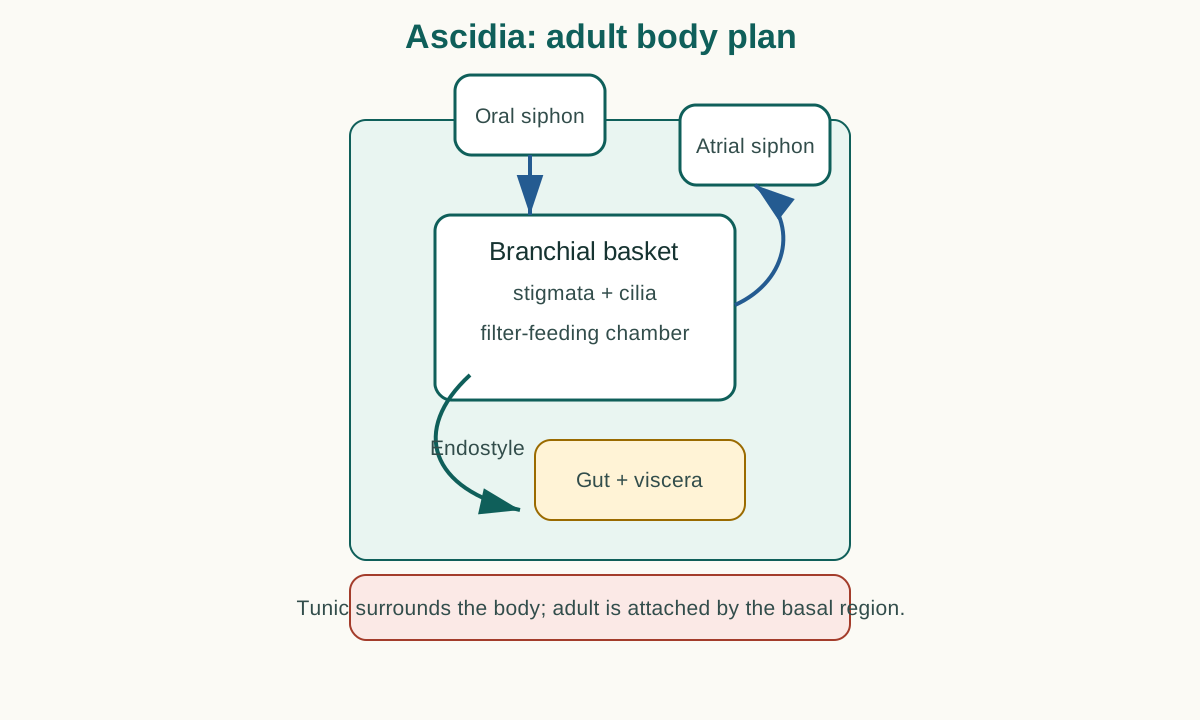
The adult is sac-like and enclosed by a tunic.
Two major openings occur near the free end:
- oral/branchial siphon: incurrent water;
- atrial siphon: excurrent water.
4. Flow-through organization
Seawater
  ↓
Oral siphon
  ↓
Branchial basket
  ↓
Stigmata
  ↓
Atrium
  ↓
Atrial siphon
  ↓
Outside
Food is separated from this water stream by mucus and ciliary transport.
5. Branchial basket
The branchial basket is an enlarged perforated pharynx.
It:
- contains numerous stigmata;
- generates and channels ciliary water flow;
- supports a mucus-based food-capture system;
- also contributes to gas exchange.
6. Endostyle
The endostyle is a ventral, ciliated, mucus-secreting pharyngeal organ.
Functions:
- secretion of mucus;
- trapping suspended particles;
- ciliary transport of the mucus-food sheet;
- iodine-related physiology that supports homology with the vertebrate thyroid system.
7. Filter feeding
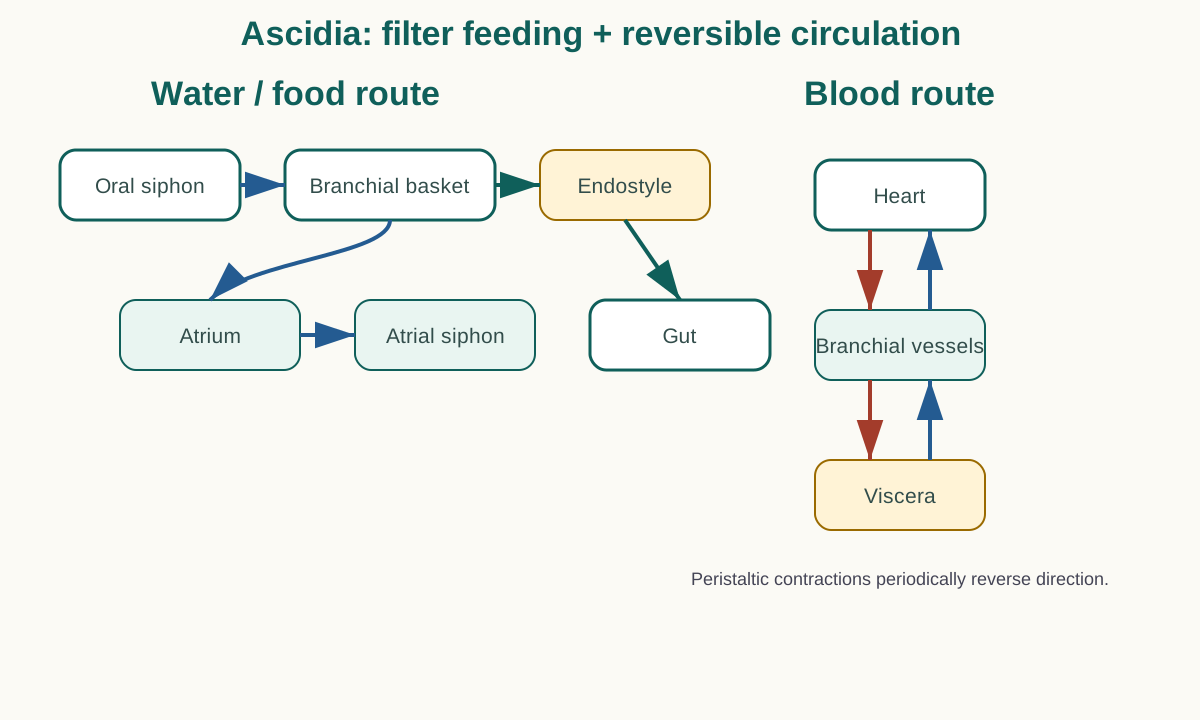
Water pathway
Oral siphon → pharynx → stigmata → atrium → atrial siphon
Food pathway
Suspended particles
  ↓
Endostylar mucus
  ↓
Mucus sheet
  ↓
Dorsal food cord
  ↓
Esophagus → stomach → intestine
Cilia are the major driving mechanism.
8. Digestive system
The gut is typically U-shaped:
mouth → pharynx → esophagus → stomach → intestine → rectum → anus opening into the atrial cavity.
The compact loop is compatible with a sessile sac-like body.
9. Respiration
There are no vertebrate-type gills. Gas exchange occurs largely across the vascular branchial basket and other body surfaces exposed to water.
The same pharyngeal architecture therefore integrates feeding and respiration.
10. Circulatory system
The ascidian heart is a simple tubular peristaltic pump within a pericardial region.
A simplified pathway is:
Heart → branchial/visceral vessels → tissues → returning channels → heart
Periodic reversal
The striking feature is that peristaltic contraction periodically reverses direction. When the wave reverses, blood flow through the broader vascular network also reverses.
This is possible because the system is not organized like a vertebrate heart with a permanent one-way valvular circuit.
11. Nervous system
The adult has a reduced nervous system centered on a ganglion between the siphons. The larva possesses a much more conspicuous dorsal neural system and sensory vesicle.
Metamorphosis therefore includes neural reduction and reorganization.
12. Excretion
There is no vertebrate-style kidney. Nitrogenous wastes are handled by diffusion and specialized storage/excretory cells or structures, varying among ascidians.
13. Reproduction
Many ascidians are hermaphroditic.
- gonads produce both types of gametes;
- gametes pass into the atrial system and then outside;
- fertilization is commonly external;
- development is indirect;
- a tadpole larva is produced.
14. Tadpole larva
The larva is a short-lived free-swimming dispersal stage.
Chordate features include:
- tail notochord;
- dorsal hollow nerve cord;
- post-anal tail;
- segmented tail muscles;
- pharyngeal region;
- sensory vesicle;
- adhesive papillae.
15. Retrogressive metamorphosis
Retrogressive metamorphosis is the transformation in which prominent larval locomotory and chordate structures are lost, reduced or reorganized as the animal becomes a sessile adult.
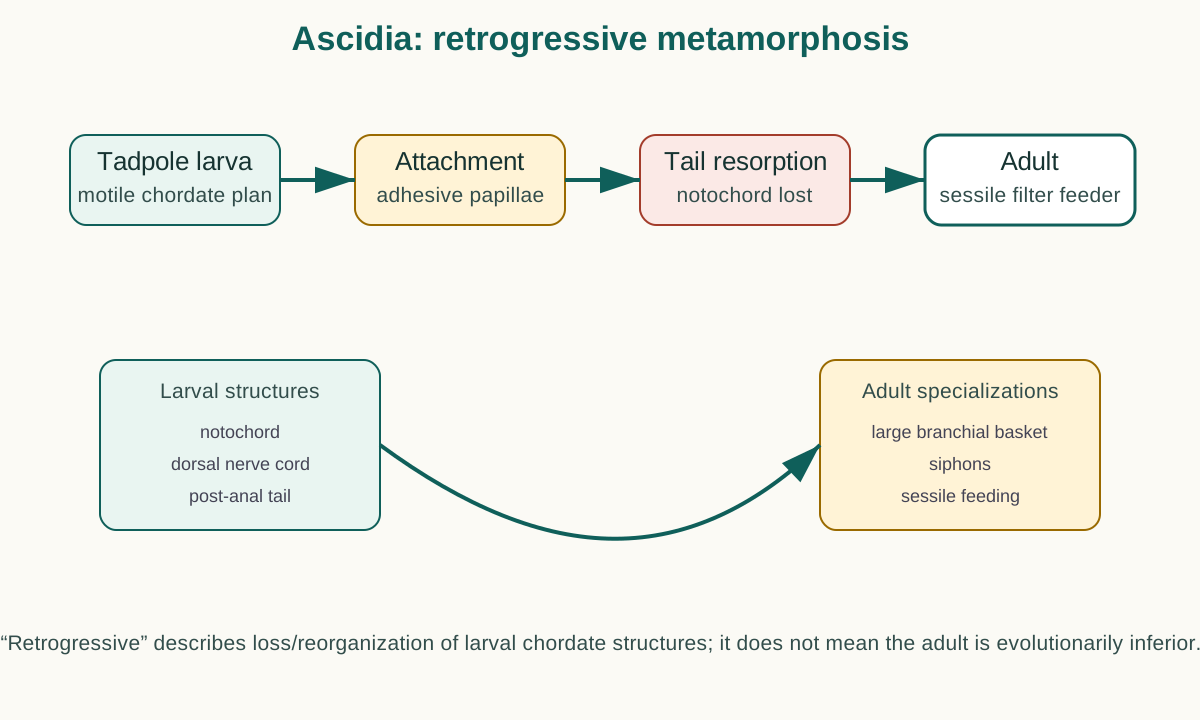
Main events:
- attachment by adhesive papillae;
- resorption of the tail;
- loss of the notochord and tail musculature;
- major reorganization of the larval nervous system;
- rotation/reorientation of the body;
- enlargement of the branchial basket;
- maturation of the U-shaped gut;
- establishment of the sessile filter-feeding adult.
“Retrogressive” does not mean evolutionarily inferior. The adult is specialized for a different ecological role.
16. Is adult Ascidia really a chordate?
Yes.
Evidence:
- larval notochord;
- dorsal hollow nerve cord;
- post-anal tail;
- pharyngeal apparatus;
- adult endostyle;
- modern molecular placement of Tunicata as the sister lineage of Vertebrata within Olfactores.
The life cycle, not adult appearance alone, establishes chordate identity.
17. Affinities
With Cephalochordata
Shared: chordate pharyngeal apparatus, endostyle and developmental body-plan features.
Differences: adult ascidians are sessile and lose the notochord; lancelets retain the classic chordate axial plan as adults.
With Vertebrata
Deep shared features include chordate developmental architecture and the endostyle–thyroid relationship. Modern molecular phylogeny strongly links Tunicata and Vertebrata as sister lineages.
18. Section A — one-mark capsule
Retrogressive metamorphosis: transformation in which prominent larval structures are reduced or lost in the adult.
Tunic: the protective extracellular coat around the ascidian body.
Stigmata: numerous openings in the branchial basket through which water passes to the atrium.
Endostyle: a ventral ciliated mucus-secreting pharyngeal organ used in suspension feeding.
Special feature of the ascidian heart: periodic reversal of peristaltic pumping direction.
19. Section B — model answer
Is adult Ascidia really a chordate?
Yes. Although the adult lacks the obvious notochord and post-anal tail, the tadpole larva possesses a notochord, dorsal hollow nerve cord and post-anal tail. The adult retains a large pharyngeal basket and endostyle. The larval axial structures are lost or reorganized during metamorphosis. Chordate identity therefore depends on the complete life cycle.
20. Section C — model long answer: filter feeding
- cilia draw water through the oral siphon;
- water enters the branchial basket;
- the endostyle secretes mucus;
- particles become trapped;
- cilia move the food-laden mucus dorsally;
- the food cord reaches the esophagus;
- filtered water crosses the stigmata into the atrium;
- water leaves through the atrial siphon.
A labelled flow diagram should accompany the answer.
21. Section C — model long answer: circulation
The heart is tubular and peristaltic. Blood is pumped through branchial and visceral vascular pathways. After a period of pumping in one direction, the contraction wave reverses, producing reversed circulation through the network. This reversible arrangement is a characteristic tunicate solution to internal transport.
22. Common mistakes
- placing a notochord in the adult;
- reversing oral and atrial siphon functions;
- treating stigmata as the structures that capture food;
- confusing pumping reversal with physical rotation of the heart;
- interpreting “retrogressive” as evolutionary inferiority.
23. Quick revision matrix
| Concept | Memory line |
|---|---|
| oral siphon | water in |
| atrial siphon | water out |
| branchial basket | filter |
| endostyle | mucus trap |
| stigmata | water to atrium |
| tunic | external coat |
| heart | tubular, peristaltic |
| circulation | periodically reverses |
| tadpole | chordate plan obvious |
| metamorphosis | larval axis lost, feeding adult built |
24. Self-test
Why does water not carry all food particles out through the atrial siphon?
Because particles are trapped in endostylar mucus and moved to the digestive tract before the filtered water reaches the atrium.Why does loss of the adult notochord not remove Ascidia from Chordata?
The notochord occurs in the larval stage; diagnostic characters may be stage-specific.25. Transfer challenge
A sessile marine adult lacks a notochord, but its swimming larva has a notochord, dorsal nerve cord and post-anal tail. Should the adult’s appearance outweigh developmental evidence?
No. The developmental body plan has greater phylogenetic value and supports tunicate/chordate identity.
26. Research-backed update notes
- Periodic reversal of ascidian heart flow is experimentally documented.
- The endostyle functions in food capture and shares deep homology with the thyroid system.
- Tunicates are the living sister lineage of vertebrates in modern phylogenomics.
- “Retrogressive” is descriptive developmental terminology, not a ranking of evolutionary worth.
References for Course Authors / Verification
- National University Zoology syllabus, paper 223101.
- OpenStax Biology 2e, Chordates.
- Peer-reviewed study of blood circulation in the ascidian tunicate Corella inflata.
- Reviews of tunicate development, heart and muscle evolution.
- Literature on endostyle–thyroid evolution.
Next Lecture
Lecture 03 — Branchiostoma: adult chordate body plan, suspension feeding, circulation and affinities.