Branchiostoma
The Puzzle
Branchiostoma (amphioxus/lancelet) looks fish-like and retains a notochord, dorsal nerve cord, pharyngeal slits and post-anal tail in the adult. Yet it is not a vertebrate.
The key lesson is:
Similarity reveals affinity; diagnostic differences define taxonomic boundaries.
1. Systematic position
- Phylum: Chordata
- Subphylum: Cephalochordata
- Class: Leptocardii
- Order: Amphioxiformes / Branchiostomiformes, depending on the source
- Family: Branchiostomatidae
- Genus: Branchiostoma
The name Cephalochordata refers to the extension of the notochord to the anterior end.
2. Habitat and mode of life
Lancelets inhabit shallow marine sandy bottoms. Much of the body is commonly buried while the anterior end remains exposed to water. They are ciliary suspension feeders.
3. External morphology
The body is elongated, laterally compressed and translucent.
Important features:
- no true head;
- no paired fins;
- median fin folds;
- oral cirri;
- ventral atriopore;
- posterior anus;
- post-anal tail;
- serial V-shaped myotomes.
Myotomes are important for locomotion and for comparison with vertebrate axial segmentation.
4. Five chordate hallmarks in the adult
Branchiostoma retains:
- notochord;
- dorsal hollow nerve cord;
- pharyngeal slits;
- endostyle;
- post-anal tail.
It is nevertheless not a vertebrate because it lacks a cranium, true vertebral column, jaws, paired appendages, a chambered heart and the derived complexity of vertebrate sensory and excretory systems.
5. Feeding apparatus
Major components:
- oral hood;
- oral cirri;
- ciliary wheel organ region;
- velum;
- large pharynx;
- numerous pharyngeal slits;
- endostyle;
- epipharyngeal groove;
- atrium;
- atriopore.
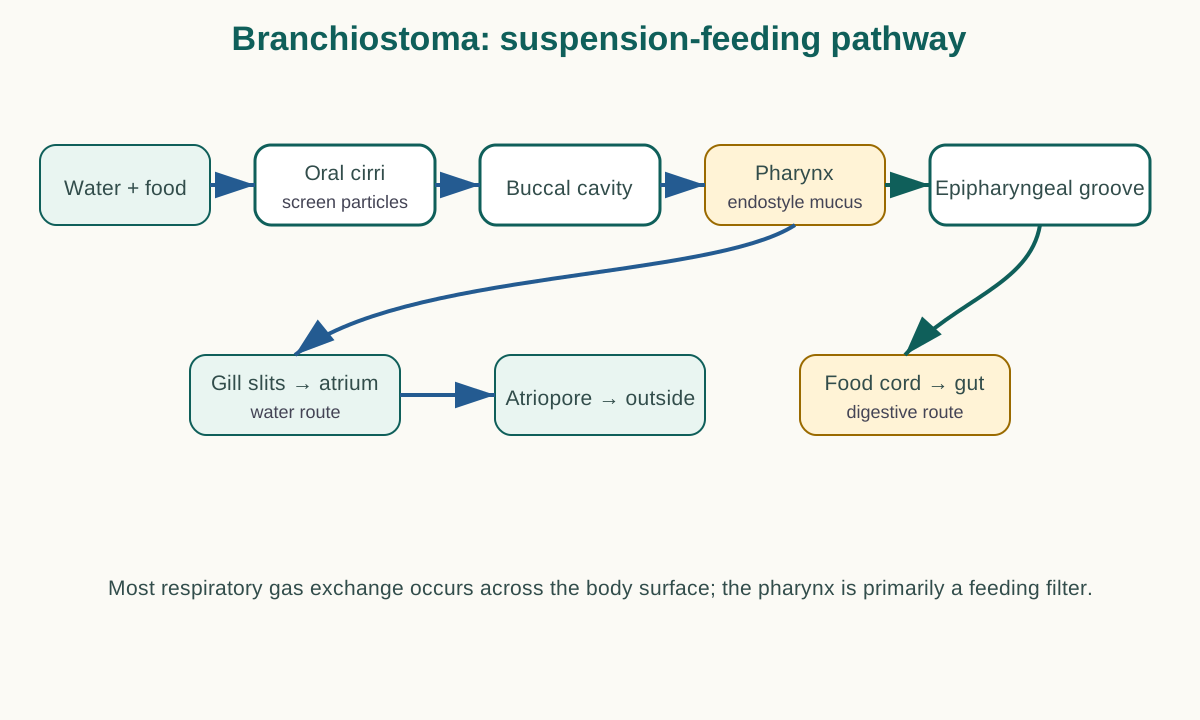
6. Feeding mechanism
- cilia draw water toward the mouth;
- oral cirri screen coarse material;
- water enters the pharynx;
- the endostyle secretes mucus;
- suspended particles become trapped;
- cilia move the mucus-food mass dorsally to the epipharyngeal groove;
- the food cord moves toward the esophagus;
- filtered water passes through pharyngeal slits into the atrium;
- water leaves through the atriopore.
WATER: mouth → pharynx → slits → atrium → atriopore
FOOD: mucus trap → epipharyngeal groove → esophagus → gut
7. Are the pharyngeal slits true fish gills?
The classical name “gill slits” can be misleading. In Branchiostoma, the pharyngeal region is primarily a feeding filter, while much gas exchange occurs across the general body surface.
8. Digestive system
The alimentary canal includes mouth, buccal cavity, pharynx, esophagus, intestine and anus.
A prominent hepatic caecum/diverticulum arises from the anterior intestine. Modern studies show that its epithelial cells can phagocytose food particles directly, in addition to extracellular digestion.
9. Circulation
Branchiostoma has an organized closed vascular pattern but no true chambered heart.
A simplified route is:
Ventral vascular region
 → afferent branchial vessels
 → pharyngeal vascular network
 → efferent vessels
 → dorsal aorta
 → body
 → venous return
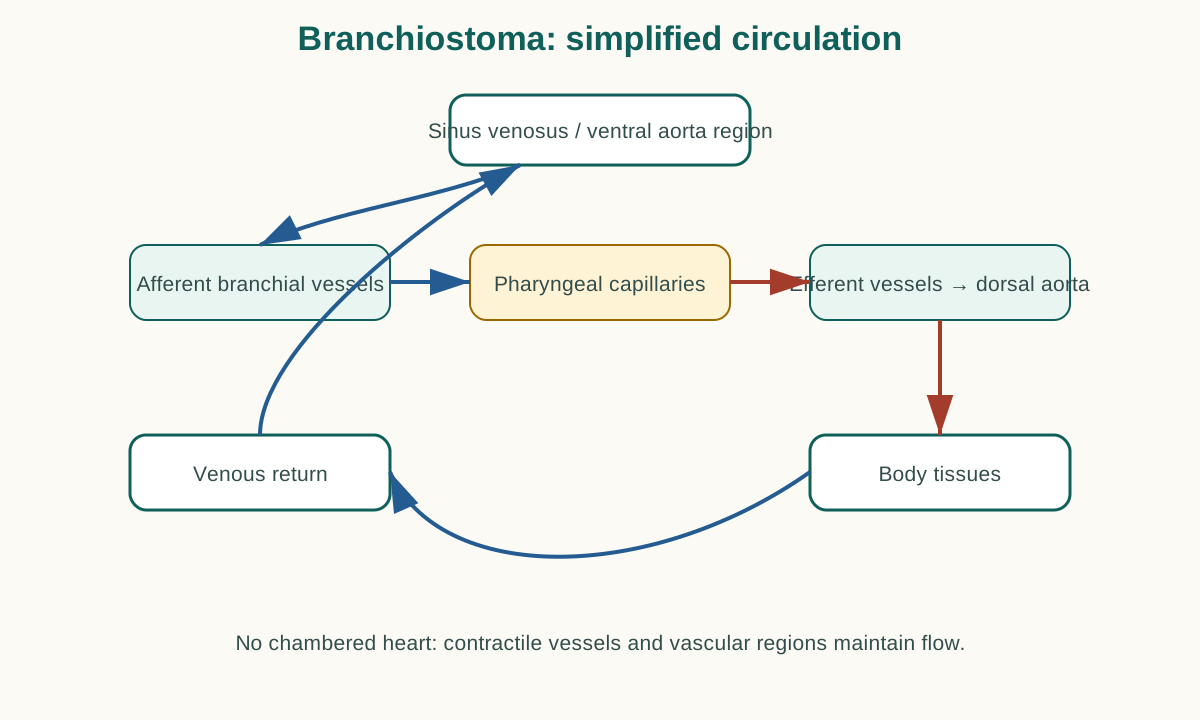
Contractile vascular regions maintain flow.
10. Respiration
Most gas exchange occurs across the thin body surface and other vascular surfaces in contact with seawater.
11. Excretion
Excretion is carried out by segmentally arranged protonephridial units with characteristic flagellated solenocytes.
This is not simply a miniature vertebrate kidney.
12. Nervous and sensory system
The dorsal hollow nerve cord lies above the notochord. Its anterior region is only modestly enlarged and no cranium surrounds it.
Simple photoreceptive, epithelial and mechanosensory systems are present, but vertebrate paired sense-organ complexity is absent.
13. Reproduction and development
Sexes are separate.
- numerous gonads occur along the body;
- there are no true gonoducts;
- gametes enter the atrial cavity;
- they leave through the atriopore;
- fertilization is external;
- development includes a free-swimming larva.
14. How to discuss affinities
A strong affinity answer requires:
- similarities;
- differences;
- interpretation.
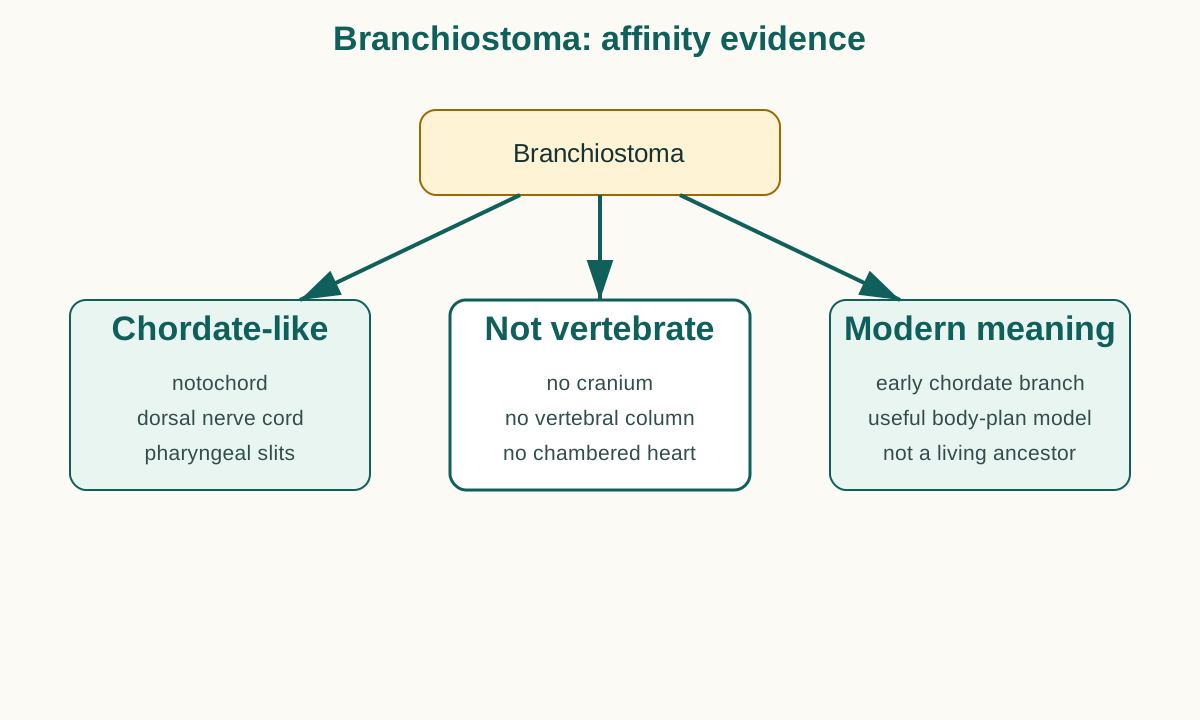
15. Affinity with vertebrates
Shared features:
- notochord;
- dorsal hollow nerve cord;
- pharyngeal apparatus;
- post-anal tail;
- myotomes;
- dorsal aortic pathway;
- endostyle–thyroid evolutionary connection.
Important differences:
- no cranium;
- no vertebral column;
- no chambered heart;
- no jaws;
- no paired appendages;
- no vertebrate-style paired sensory organs or kidneys.
Branchiostoma is therefore highly informative for comparison but is not a vertebrate.
16. Affinity with tunicates
Shared features include the endostyle, pharyngeal suspension feeding and the chordate developmental plan.
The major contrast is that adult lancelets retain the axial chordate plan, whereas adult ascidians remodel and lose major larval axial structures.
Modern phylogeny
Despite its vertebrate-like morphology, Branchiostoma is not the closest living sister lineage of vertebrates. Molecular phylogenomics supports Tunicata + Vertebrata as Olfactores.
17. Why “living ancestor” is wrong
Branchiostoma is a modern living lineage with its own evolutionary history. It should be described as:
- an early-branching living chordate lineage;
- a useful comparative model;
- an animal retaining several ancestral-looking chordate features.
It should not be called the direct ancestor of fishes or humans.
18. Section A — one-mark capsule
Filter feeding: capture of small suspended food particles from water.
Endostyle: ciliated mucus-secreting groove in the pharyngeal floor.
Myotome: a serial block of axial muscle.
Atriopore: external opening through which water leaves the atrium.
Solenocyte: a flagellated terminal excretory cell associated with lancelet protonephridia.
19. Section B — model answer: feeding mechanism
Cilia draw water through the mouth. Oral cirri screen large particles. The endostyle secretes mucus, which traps suspended food. Cilia move the food-laden mucus to the epipharyngeal groove and then to the esophagus. Filtered water crosses the pharyngeal slits into the atrium and leaves through the atriopore.
20. Section C — long answer: feeding mechanism
A full answer should identify oral cirri, buccal region, pharynx, endostyle, pharyngeal slits, epipharyngeal groove, atrium and atriopore, then trace water and food as two separate streams.
21. Section C — long answer: affinities
Discuss vertebrate-like chordate features, major non-vertebrate differences, similarities with tunicates and the modern phylogenetic interpretation.
Conclude that Branchiostoma is an independent cephalochordate lineage that retains a highly informative chordate body plan.
22. Common mistakes
- calling Branchiostoma a fish;
- giving it a true chambered heart;
- treating its pharyngeal slits as exact fish gills;
- sending food out through the atriopore;
- giving it gonoducts;
- calling it a direct ancestor of vertebrates.
23. Quick revision matrix
| Structure | Function |
|---|---|
| oral cirri | screen coarse particles |
| endostyle | mucus trap |
| pharyngeal slits | water to atrium |
| atriopore | water exit |
| epipharyngeal groove | food transport |
| hepatic diverticulum | digestion/absorption |
| myotomes | axial locomotion |
| solenocytes | excretion |
| notochord | axial support |
24. Self-test
Why is Branchiostoma not a vertebrate despite retaining all five chordate hallmarks?
It lacks the defining vertebrate innovations such as a cranium, true vertebral column and multiple derived organ-system features.Where do food and water pathways separate?
Within the pharyngeal filtering system: food is retained in mucus while water passes through the slits to the atrium.25. Transfer challenge
An adult chordate retains a notochord, a large filter-feeding pharynx and segmented myotomes but lacks a cranium and vertebral column.
The stronger diagnosis is Cephalochordata, not Vertebrata.
26. Research-backed update notes
- Modern research confirms complex feeding and digestion, including phagocytic intracellular digestion in the hepatic diverticulum.
- Cephalochordates are highly informative but are not living ancestors.
- Molecular phylogenomics places Tunicata closer to Vertebrata than Cephalochordata.
References for Course Authors / Verification
- National University Zoology syllabus, paper 223101.
- OpenStax Biology 2e, Chordates.
- Peer-reviewed research on intracellular digestion in Branchiostoma.
- Modern chordate phylogenomics literature.
Next Lecture
Lecture 04 — Myxine and Petromyzon: living jawless vertebrates, cyclostome comparison, ammocoete larva and lamprey life cycle.